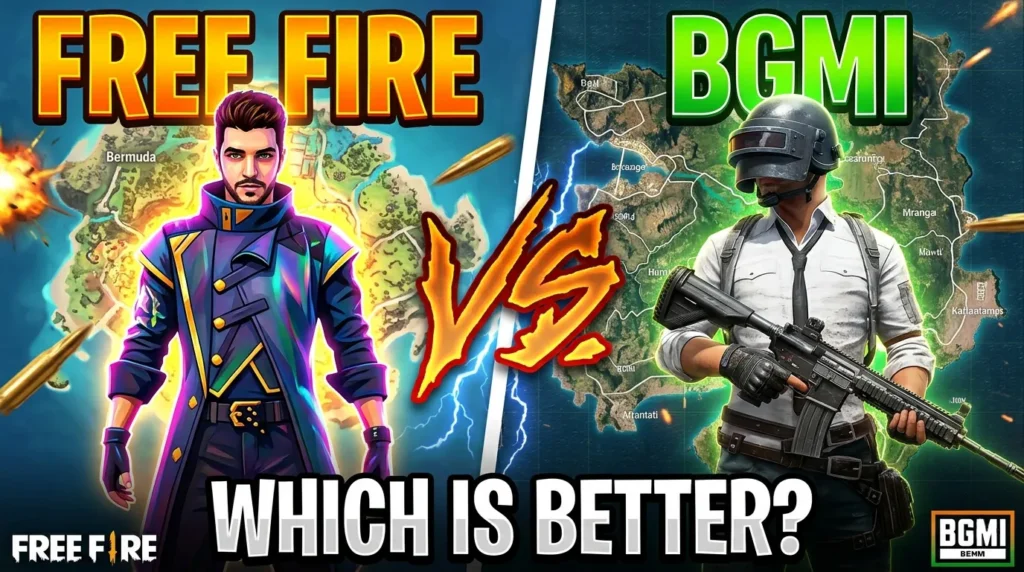
Here’s something most comparison guides don’t tell you upfront: BGMI is only available in India. If you’re reading this from Brazil, Indonesia, the Middle East, or anywhere else outside India, Free Fire is the only option between these two that you can actually download and play today. That single fact reshapes the entire “which is better” question — because for most of the world, it isn’t a choice at all.
For players in India, though, the comparison is real and worth thinking through. Both games pull massive numbers. Both have active ranked modes, esports scenes, and passionate communities. But they’re built for genuinely different players. This breakdown goes category by category — no filler, no vague conclusions — so you can figure out which one actually fits your situation.
What Is BGMI and How Is It Different From PUBG Mobile?
Before diving into the comparison, a quick clarification that confuses a lot of international players: BGMI (Battlegrounds Mobile India) is the India-exclusive version of PUBG Mobile. It was developed by Krafton after PUBG Mobile was banned in India in 2020. BGMI launched in July 2021, was itself banned briefly in 2022, and returned in May 2023. The gameplay is nearly identical to PUBG Mobile, but BGMI includes India-specific features, local data compliance, and its own tournament ecosystem.

So when people ask “Free Fire vs BGMI,” they’re really asking “Free Fire vs PUBG Mobile, but specifically in the Indian context.” That distinction matters when comparing their global reach.
Gameplay: Fast Arcade vs Slow Tactical
This is the biggest split between the two games — not graphics, not device requirements. It’s the pace.
Free Fire drops 50 players onto a relatively compact map. A standard Battle Royale match lasts roughly 10–15 minutes. The game leans heavily into character abilities, pet skills, Gloo Walls, and fast rotations. You can rush an enemy, gloo up, and trade in under 30 seconds. The tempo is high from the first minute.
BGMI drops 100 players onto much larger maps like Erangel or Miramar. Matches routinely run 25–35 minutes. The gunplay is grounded in realistic ballistics — bullet drop, recoil patterns, lead targets at distance. There are no character abilities or pets. What you carry is what you get. Positioning and patience beat reflexes far more consistently than in Free Fire.
Neither pace is objectively better. But if you have 15 minutes between classes or during a commute, Free Fire fits that window cleanly. If you want to sit down for a proper session and grind ranked, BGMI’s longer format rewards that kind of commitment.

Pro Tip: Free Fire’s Clash Squad mode actually bridges this gap somewhat — it’s a shorter, more tactical format that feels closer to BGMI’s round-based intensity. If you play Free Fire but miss BGMI’s structured combat, Clash Squad is worth exploring.
Graphics and Visual Style: Realism vs Accessibility
| Category | Free Fire | BGMI |
|---|---|---|
| Engine | Proprietary (optimized for mobile) | Unreal Engine (console-grade) |
| Visual Style | Vibrant, arcade, stylized | Realistic, high-fidelity, cinematic |
| Max Graphics Setting | HD / Extreme | Ultra HD / 90 FPS |
| Character Design | Stylized with skins, outfits, effects | Military-realistic, detailed |
| Map Aesthetics | Colorful, fast-read environments | Grounded, immersive terrain detail |
BGMI looks significantly better on a flagship or mid-range phone with the settings maxed out. The texture quality, lighting, and environment detail are noticeably stronger. If you care about the game looking cinematic, BGMI wins that category without much debate.
Free Fire’s visuals are deliberately stylized — think more cartoon-action than military simulation. On a good phone with Extreme graphics enabled, it looks sharp and clean. But it’s a different design philosophy, not a technical limitation. Garena chose accessibility over photorealism, and that choice is why Free Fire runs on phones that struggle to boot BGMI.
Device Requirements: The Biggest Practical Difference
This is where the comparison becomes very concrete for a large portion of the global player base.
Free Fire minimum requirements:
- Android 4.0.3 or above
- 1 GB RAM (2 GB recommended)
- ~710 MB download size
BGMI minimum requirements:
- Android 5.1.1 or above
- 2 GB RAM (3 GB recommended for smooth gameplay)
- ~721 MB base download, larger with HD resources
On paper, the requirements look similar. In practice, the difference is significant. Free Fire is designed to run smoothly on a 2 GB RAM budget phone from 2019. BGMI on a 2 GB device works but stutters — you’ll notice frame drops in high-action moments. BGMI really performs at its best with 4 GB RAM or more.
Free Fire has crossed 1.3 billion lifetime downloads globally Co-op Board Games — a number built almost entirely on low-to-mid range device accessibility in developing markets. That accessibility gap between the two games directly explains their respective audience sizes around the world.
Common Mistake: Players sometimes try to run BGMI on a device that barely meets the minimum specs, then conclude the game is bad. BGMI at minimum settings is a poor experience compared to Free Fire at minimum settings. Device-matched comparisons matter more than raw spec numbers.
Map Design and Match Structure
Free Fire has three main maps — Bermuda, Kalahari, and Purgatory — each compact enough that you’re rarely more than 90 seconds away from an engagement. The zone moves aggressively, which keeps matches moving. If you land in a hot drop and die early, you’re back in a new lobby in under two minutes.
BGMI’s maps are significantly larger. Erangel alone covers 8×8 km of playable area. Long vehicle rotations, camping-friendly terrain, and slow zone movements mean you can go 10 minutes without a single fight if you play passively. That’s frustrating for action-seekers but rewarding for players who enjoy strategic positioning and reading the zone.
The match structure difference also affects how you learn the game. In Free Fire, you accumulate game sense faster because you play more matches per hour. In BGMI, a single match teaches you more about long-range positioning, loot management, and late-game circle strategy — but you get fewer reps per session.
Monetization: Which Game Is More Fair to Free-to-Play Players?
Both games are free to download and free to play competitively. Neither locks gameplay-impacting content behind paywalls in the traditional sense. But their monetization models feel meaningfully different.
Free Fire Max offers daily redeem codes and frequent event rewards, making it significantly more accessible for players who don’t spend real money. BGMI focuses more on event logins and achievement-based rewards, making premium items harder to access without spending. India TV News
Free Fire’s cosmetic events are frequent and often achievable without spending diamonds — especially during anniversary seasons and major collaborations. BGMI’s premium items tend to carry higher price points, and the crate system requires more investment to access specific skins.
For free-to-play players or those on a tight budget, Free Fire gives you more visual variety without requiring real spending. BGMI isn’t predatory by any means, but the gap between a free-to-play BGMI player and a paying one is visually wider.
Quick Note: If you’re playing Free Fire and looking to grab event items without spending, keep an eye on our Free Fire daily redeem codes page — active codes are updated regularly.
Esports Scene: Global Scale vs Regional Depth
This is a category where the two games tell very different stories.
Free Fire’s esports ecosystem is genuinely global. The FFWS 2024 Global Finals drew over 750,000 peak concurrent viewers, and Free Fire ran more than 1,300 tournaments in total across its esports history, generating over $4.8 million in prize pools in 2025 alone. Co-op Board Games Free Fire also appeared at the 2024 Esports World Cup in Riyadh — a meaningful milestone that puts it alongside titles like CS2 and Dota 2 in terms of multi-title event recognition.
BGMI’s esports scene is smaller in global scope but exceptionally deep within India. BGMI has run tournaments with a cumulative prize pool exceeding $13 million Esports Charts, with flagship events like the BGMI India Series (BGIS) and BGMI Pro Series (BMPS) drawing massive domestic viewership. Teams like GodLike Esports and Gods Reign have built real fanbases through BGMI competition. Outside India, though, BGMI esports effectively doesn’t exist.
If your goal is to watch international tournaments or play in globally accessible competitions, Free Fire’s esports ecosystem is significantly larger. If you’re in India and want to follow a domestic competitive scene with real local storylines, BGMI delivers that in a way Free Fire currently can’t match on Indian soil given its 2022 ban history.
The Key Question Competitors Miss: Global Availability
Almost every comparison article treats this as a preference question — “Which do you like better?” But there’s a structural reality that most guides bury in a footnote: BGMI is geographically restricted to India.
A player in Indonesia, Nigeria, Mexico, or the UK cannot download BGMI from the Play Store. The game simply isn’t available in their region. Free Fire, by contrast, runs on servers across multiple regions — India, Southeast Asia, Latin America, the Middle East, and beyond. It has language support for dozens of markets.
This matters if you’re thinking about which community to invest in long-term. Free Fire’s global player base means your skills, game sense, and ranked progress are part of a worldwide ecosystem. You can watch international creators, follow global esports events, and compete on a server that hosts players from dozens of countries.
For anyone outside India, this comparison ends here. For Indian players, both are genuinely viable — and the rest of the factors in this guide apply.
Side-by-Side: Free Fire vs BGMI at a Glance
| Category | Free Fire | BGMI |
|---|---|---|
| Available Globally | ✅ Yes | ❌ India only |
| Match Duration | ~10–15 minutes | ~25–35 minutes |
| Players Per Match | 50 | 100 |
| Min. RAM Required | 1 GB | 2 GB |
| Character Abilities | ✅ Yes (50+ characters) | ❌ No |
| Pet System | ✅ Yes | ❌ No |
| Graphic Style | Stylized/Arcade | Realistic/High-fidelity |
| Free-to-Play Rewards | Frequent, generous | Achievement/event based |
| Esports Global Reach | 🌍 Global | 🇮🇳 India-focused |
| Monthly Active Users | ~130 million (2025) | Part of ~113M PUBG Mobile global |
Which Game Should You Actually Play?
Play Free Fire if:
- You’re outside India (BGMI isn’t available to you anyway)
- You play on a budget or mid-range phone with less than 4 GB RAM
- You prefer short, high-action matches that fit into a busy day
- You enjoy character abilities, pets, and skill-based builds
- You want more free cosmetics without spending real money
Play BGMI if:
- You’re in India with a mid-range or flagship phone
- You prefer realistic gunplay, slower tactical pacing, and longer matches
- You want to follow a vibrant domestic esports scene
- You enjoy games with no ability meta — pure positioning and aim
The honest answer isn’t that one game is better. They’re built for different sessions, different devices, and different player mindsets. The mistake is treating this as a prestige comparison — “which is the superior game” — when really it’s a lifestyle fit question.
FAQ
Is BGMI available outside India?
No. BGMI is exclusively available in India and cannot be downloaded or played in other regions. It’s the India-specific version of PUBG Mobile, developed by Krafton with data localization requirements specific to India.
Which game has better graphics, Free Fire or BGMI?
BGMI has significantly more realistic graphics, powered by Unreal Engine with high-fidelity textures and dynamic lighting. Free Fire uses a stylized, arcade-style visual approach that prioritizes performance over photorealism. On flagship phones, BGMI looks noticeably better — but Free Fire’s art style is a deliberate design choice, not a limitation.
Can Free Fire and BGMI players play together?
No. They’re entirely separate games with separate servers, accounts, and player bases. There is no crossplay or shared progression between them.
Which game has a bigger global player base?
Free Fire is significantly larger globally, with approximately 130 million monthly active players as of early 2025 and 1.3 billion lifetime downloads. BGMI’s player base is concentrated in India as part of the broader PUBG Mobile ecosystem.
Which game is better for low-end phones?
Free Fire is clearly the better choice for low-end devices. It runs on 1 GB RAM with Android 4.0.3 and is actively optimized for budget phones. BGMI works on 2 GB RAM but performs noticeably better on 4 GB or higher.
The “which is better” framing misses the point. Free Fire is a global platform with a massive player base, a generous reward system, and a low barrier to entry on nearly any Android device. BGMI is a deep, realistic tactical experience with a passionate Indian community and a strong domestic esports scene. They’re not competing for the exact same player — and whichever one you pick, you’re joining a game with millions of active players and regular updates.
If you’re on the fence about Free Fire specifically, check out our complete Free Fire character guide to get a feel for what makes its ability system different from anything BGMI offers — it’s a bigger factor than most new players expect.
Read Next:
- Free Fire vs PUBG — Which Battle Royale Wins?
- Free Fire OB48 Update — What’s New
- All Free Fire Characters in 2026
External References (open in new tab):
Helpful Resources:
Free Fire daily redeem codes→ https://freefirenation.com/free-fire-redeem-code-today/complete Free Fire character guide→ https://freefirenation.com/ff-character-in-2026/Free Fire vs PUBG→ https://freefirenation.com/free-fire-vs-pubg-which-battle-royale-wins/Free Fire OB48 Update→ https://freefirenation.com/free-fire-ob48-update-new/

Written by
Free Fire Nation Team
Free Fire Nation is a dedicated gaming editorial team covering Free Fire news, weapon guides, esports, and redeem codes since 2019. All content is tested in-game and verified against official Garena sources.
1 Discussion