
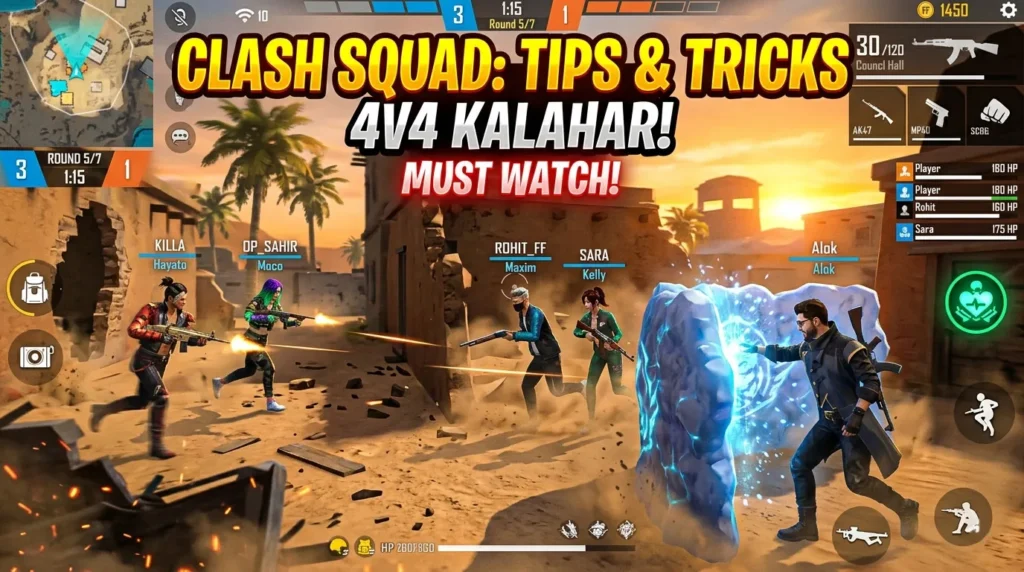
Free Fire Clash Squad Tips That Actually Win Ranked Matches in 2026
Most players who lose Clash Squad matches aren’t losing because of bad aim. They’re losing because they’re spending their coins wrong in rounds 1 and 2, and the gun disadvantage compounds from there until the match is already gone. After grinding CS ranked across hundreds of matches on mobile — from Diamond all the way to Heroic — here’s what genuinely separates the players who push rank consistently from the ones stuck in the same tier every season.
This guide covers the full picture: the economy system nobody explains properly, team roles for random queues, gloo wall placement that works on a phone screen, the best character combos for each playstyle, and the specific mistakes that kill Diamond players’ chances of hitting Heroic.
What Clash Squad Actually Tests — And Why Most Players Fail
Clash Squad is not Battle Royale with a smaller map. The two modes demand completely different skills, and players who only grind BR often carry bad habits into CS that cost them rounds before a single shot is fired.
In BR, surviving matters more than killing. In CS, you win rounds by eliminating the other team — and each round resets everyone’s gear. Survive a round with your weapon? You keep it. Die? Gone. That single mechanic changes everything about how you should play.
The four things CS actually tests: aim consistency, positioning, economy decisions, and team coordination. Of those four, economy is the one almost nobody talks about — and it’s the one that decides the most rounds, especially in ranked where everyone’s aim is reasonably close.
Common Mistake: Treating Clash Squad like a shorter Battle Royale. The zone, the buy menu, the round structure — all of it requires a different mindset from the moment you queue.
This is the section that will change your CS rank faster than anything else in this guide. Free Fire’s Clash Squad economy works on a coin system, and the decisions you make in the buy phase of rounds 1, 2, and 3 directly determine whether you can compete in rounds 5, 6, and 7.
Round 1 — The Pistol Round
Everyone starts with 500 coins. Here’s what the top players do that most players don’t: skip the G18. It costs 300 coins and is objectively worse than the free Double USP you already have. Spending those 300 coins to downgrade your pistol is one of the most common round-1 mistakes in Diamond lobbies.
Better use of your 500 coins: buy a gloo wall (200 coins) and a flashbang (200 coins), keep the free USP, and play for information rather than kills. One good wall placement can win a round-1 pistol fight against a team that bought G18s.
If your aim is reliable under pressure, the M500 at 400 coins is worth considering — one headshot kills an unarmored enemy instantly.
Round 2 — Fork in the Road
Win round 1 and you have roughly 1,500 to 2,000 coins. This is your force-buy round. Get an MP40 or Thompson, a Level 2 Helmet, and one gloo wall. You now have a massive gear advantage over a team that’s still on pistols.
Lose round 1 and you have around 800 coins. Don’t panic-buy. Get a Desert Eagle (800 coins) and play completely passively. Your job this round is to steal one weapon from an enemy, not to win. If your whole team eco rounds together, you equalize the coin gap faster.
Round 3 and Beyond
Once both teams have real weapons, the economy layer shifts. Before every buy phase, check your teammates’ coin counts. If three players have 2,000 coins each and one teammate has 300, buy two guns and drop the cheaper one. A team where everyone has a real weapon beats a team where three players are rich and one is running a pistol. Every time.
Pro Tip: In rounds 5 through 7 when coin pools are larger, minimum 3 gloo walls per round is standard. A wall costs 200 coins. Running out of walls in a final-round zone fight is an economy mistake, not a tactics mistake.
Team Roles — What Random-Queue Players Ignore
Four players, four roles. Most random-queue teams don’t discuss this, which is why most random-queue teams lose to coordinated squads even when individual skill levels are similar.
The Rusher pushes first, gains map control, and pressures the enemy into reacting. Needs high mobility and a short-range weapon (MP40, M1887). Should never push alone.
The Anchor holds the mid-range angle while the rusher pushes. Creates crossfire opportunities. Best role for players with strong aim but slower movement. SCAR or UMP works well here.
The Support carries the gloo walls, drops weapons for broke teammates, and handles revives. Alok or Dimitri as character is almost mandatory here. The support player often decides close matches not through kills but through keeping teammates alive long enough to fight back.
The Sniper/Flanker moves around the edges while the other three engage from the front. Needs patience and map knowledge. One successful flank in a round-4 or round-5 situation can swing the entire match.
If you’re solo queuing with randoms, play Anchor. Let the randoms create chaos in the front, hold your angle, clean up the 1v1s they open up, and use text chat to call enemy positions. It’s the role that wins the most games in uncoordinated teams.
Gloo Wall Placement That Wins Rounds on Mobile
The gloo wall system is where mobile players genuinely have a skill ceiling most guides never address. On PC emulators, wall placement is precise. On mobile — where 90% of FFN’s audience plays — it’s a different execution challenge entirely.
Three wall placements that work specifically on mobile:
The Cover-and-Peek Wall: Place the wall to your side, not directly in front of you. Peek from the edge of the wall rather than over it. This forces enemies to adjust their pre-aim position every time you peek, giving you a split-second advantage on each exchange.
The Revive Wall: When a teammate goes down, don’t rush to them exposed. Place one wall between you and the enemy, drop into cover, then revive. The mistake most players make is trying to drag a teammate while fully exposed. One wall is the difference between a 3v4 situation becoming a 4v4 comeback and you going down too.
The Zone-Transition Wall: As the safe zone shrinks in late rounds, players instinctively run for the center and get shot in the back. Instead, place a wall behind you before you move, then sprint. It gives you 2 to 3 seconds of rear protection during rotation — enough to reach the next piece of cover.
Quick Note: The Mr. Waggor pet generates gloo walls passively throughout the match. If you play a wall-heavy style, Waggor is arguably the highest-value pet for CS ranked — more impactful per round than most combat pets.
Best Character Combos for CS Ranked (By Playstyle)
Character selection in Clash Squad matters differently than in Battle Royale. CS fights last 3 to 5 seconds. You need burst abilities, not passive healing that activates after a fight you’ve already lost.
| Playstyle | Active Skill | Passive 1 | Passive 2 | Passive 3 |
|---|---|---|---|---|
| Aggressive Rusher | Alok (Drop the Beat) | Jota (HP on knock) | Hayato (damage boost) | D-Bee (movement accuracy) |
| Support / Anchor | Dimitri (Healing Zone) | Kapella (heal boost) | Olivia (revive HP) | Otho (enemy reveal on kill) |
| Flanker / Stealth | Wukong (Camouflage) | Moco (tag on hit) | Rafael (silenced shots) | Kelly (sprint speed) |
| Defensive Hold | Chrono (Time Turner) | Kenta (frontal shield) | Andrew (vest durability) | Ford (zone resistance) |
A note on the current meta: Alok received a buff that increased his healing rate slightly, making the Alok + Dimitri support combination the strongest two-character foundation you can build around in squad play. Meanwhile, Tatsuya’s dash got a cooldown nerf, so the hyper-rush playstyle that dominated a couple of patches ago is less reliable now. Chrono’s shield was also reduced, which hurts pure defensive builds in late-round situations.
If you’re just unlocking characters and working with a limited roster, Alok as your active skill plus any three passive skills that reduce damage or increase mobility will outperform most character combinations at Diamond rank and below.
Map Control: The Three Main CS Maps and Where to Hold
Clash Squad rotates across five maps, but Bermuda, Kalahari, and Alpine are where the majority of ranked matches happen. Each has a specific control point that determines who wins the most rounds.
Bermuda (Clock Tower area): The rooftop positions are the most contested real estate in this map. The team that holds high ground controls sightlines to three approach routes simultaneously. If your team has a sniper, reaching the Clock Tower roof in the first 10 seconds of the round is worth the sprint. If the enemy controls it, use smoke to push the stairs rather than trying to peek from ground level.
Kalahari: Mid-map compound is the key. It’s a chokepoint that forces enemies into one of two approach angles. Hold the compound with your anchor, send the rusher to the left flank, and use gloo walls to control the right side. Teams that try to fight Kalahari from the edges usually lose on zone.
Alpine: The tightest CS map. Long sightlines make snipers more valuable here than on any other map. Pick up a Kar98k if it’s in the buy menu — at CS ranges, it one-shots unarmored enemies and two-shots armored ones with body shots. The center buildings are the position every team fights for in rounds 3 and 4.
Mistakes Diamond Players Make That Heroic Players Don’t
Getting stuck at Diamond is almost always about one of these five habits. Fix any two and your star gain rate changes noticeably.
Peeking the same angle twice. If you miss a peek and retreat, the enemy now has your exact position pre-aimed. Move 3 to 5 steps sideways before peeking again. The angle shift is small — but it’s enough to beat their pre-aim.
Rushing without information. “Rushing” without knowing where at least one enemy is just means running into a crossfire. Your sniper or flanker should hit someone before your rusher moves. One 150-damage body shot means your rusher is pushing a half-health enemy. That’s a completely different fight.
Saving coins when you’re down 0-3. When you’re losing badly, Garena’s losing-streak bonus equalizes your buying power. The enemy’s gear advantage is capped. This is the moment to full-buy, not eco. Most Diamond players eco when they’re down and fall further behind instead of using the catch-up mechanic the game is offering them.
Not buying mushrooms before round 7. Mushrooms replenish EP, and characters like Alok and K convert EP to HP. In a final round, spending 100 coins on a mushroom to top off your EP before activating Alok’s skill is a free 50 HP. Most players skip it.
Playing aggressively at 3-3. A 3-3 scoreline means neither team has pressure. The team that survives that round by playing slower and forcing the zone to help them wins statistically more often than the team that force-pushes. Your best play in a tied final round is often doing almost nothing until the enemy makes the first mistake.
The Takeaway
The biggest separator between Diamond and Heroic in Clash Squad isn’t game sense or aim — it’s economic discipline in the first three rounds and wall placement under pressure in the last two. Get those two things right consistently and your rank will move. Keep playing round 1 the same way you always have and the results will keep being the same.
If you’re building out your character roster for CS, check out our Free Fire character guide to compare skill values and unlock priorities. And if sensitivity is affecting your peeks and wall placements, the Free Fire sensitivity calculator on FreeFireNation.com can help you dial in settings for mobile specifically.
What’s your current CS rank — and which of these is the mistake you’re making most? Drop it in the comments.
Frequently Asked Questions
What is the best weapon for Clash Squad in Free Fire?
The MP40 is the most consistent CS weapon across all ranges for its price. Pair it with an M1887 for close-range dominance, or with a SCAR if you want more versatile mid-range control. Avoid the Vector Akimbo outside of extremely close fights — its damage drops sharply beyond 5 meters.
How do I win Clash Squad with random teammates?
Play the Anchor role. Hold angles, call enemy positions in text chat, and avoid solo pushes. Let your randoms create pressure in the front and clean up the 1v1 situations they open. Drop a weapon for any teammate who’s broke in rounds 2 and 3 — a four-weapon team beats a three-weapon team with a rich bench almost every time.
How many gloo walls should I buy per CS round?
Minimum two per round, always. In rounds 5 through 7 when your coin pool is larger, three to four walls is standard. At 200 coins each, running out of walls in a late-round fight is a buying mistake more than a tactics one.
Which character is best for Clash Squad beginners?
Alok is the safest starting point. His Drop the Beat active skill heals nearby teammates and boosts movement speed — it helps your whole squad, not just you, and it works whether you’re pushing or retreating. Beginners who don’t yet have a clear role will get more value from Alok than from any other character.
Does eco round strategy work against aggressive teams?
Yes, specifically because of the losing-streak coin bonus. If an aggressive team beats you in round 1, eco round 2 — take the Desert Eagle, play passively, and try to steal one weapon. By round 3, your coin pool has recovered enough to full-buy while the aggressive team starts making greedy purchases that leave them under-armored.

Written by
Free Fire Nation Team
Free Fire Nation is a dedicated gaming editorial team covering Free Fire news, weapon guides, esports, and redeem codes since 2019. All content is tested in-game and verified against official Garena sources.
4 Discussions