
Written by the FreeFireNation team. Every attachment breakdown here is tested in live matches across Battle Royale and Clash Squad, and refreshed each season as Garena adjusts weapon stats.
What Is the Stock Attachment in Free Fire?
The Stock attachment is one of the six core weapon attachments in Free Fire. It’s built to do two things at once: stabilize your gun’s aim while firing, and increase your movement speed while the weapon is equipped. In practice, that means less muzzle climb during sustained fire and slightly faster repositioning during a gunfight — two things that matter a lot in Free Fire’s fast, close-quarters combat style.
It’s easy to overlook Stock in favor of flashier attachments like scopes or extended magazines, but on the right weapons it’s one of the highest-impact picks available, especially for players who struggle with recoil control during longer engagements.
Quick facts:
- Function: Improves aim stability (reduces recoil) + increases movement speed while firing
- Levels: 1, 2, and 3
- Best weapon types: ARs, LMGs, and SMGs with noticeable recoil
- Pickup locations: Ground loot, houses, supply crates, airdrops
- Compatible with: Select Assault Rifles, LMGs, and a handful of SMGs — not every weapon has a stock slot
How the Stock Attachment Works
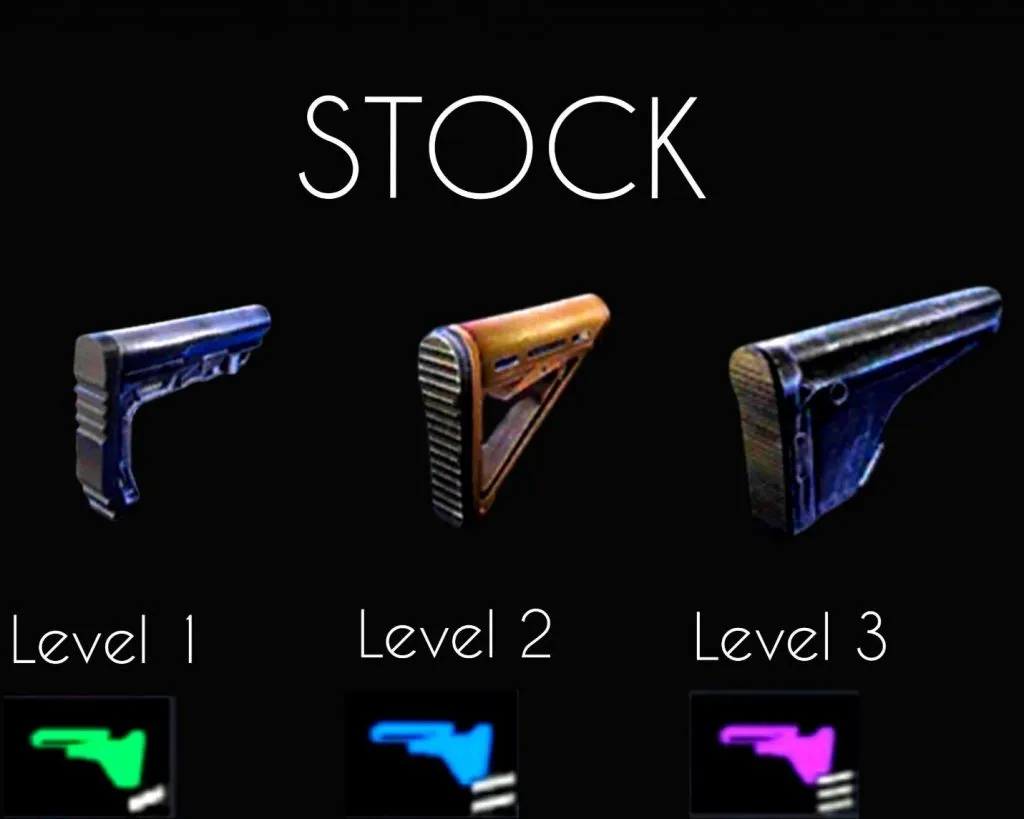
Stock scales across three upgrade levels, and each level improves both of its core effects together — you can’t get more stability without also gaining the movement speed bonus, since they’re built into the same attachment.
| Level | Aim Stability | Movement Speed While Firing |
|---|---|---|
| Level 1 | Slightly more stable aim | Small movement speed increase |
| Level 2 | Noticeably more stable aim | Moderate movement speed increase |
| Level 3 | Highly stable aim | Highest movement speed increase |
The practical effect: at Level 3, your gun’s crosshair climbs far less during sustained fire, and you can strafe and reposition more freely without your aim falling apart — a combination that’s especially valuable in close-to-mid-range spray fights where standing still gets you killed.
Stock vs Foregrip: What’s the Difference?
Players often confuse Stock with Foregrip since both attachments reduce recoil, but they work differently and serve slightly different purposes:
| Attachment | Primary Effect | Secondary Effect | Best For |
|---|---|---|---|
| Stock | Aim stability (recoil control) | Movement speed while firing | Guns you fire while moving/strafing |
| Foregrip | Vertical + horizontal recoil reduction | None | Guns you fire from a stationary position |
If you’re the type of player who strafes constantly during fights — moving side to side to dodge incoming fire while still shooting — Stock is generally the better pick, since the movement speed bonus compounds with the recoil reduction. If you tend to hold an angle and fire from a fixed position, Foregrip’s pure recoil reduction may serve you slightly better. Many top-tier weapons let you run both at once if they have the attachment slots, which is the ideal setup when available.
Best Guns to Pair With Stock
Stock isn’t available on every weapon, and it matters more on some guns than others. Here’s where it has the biggest impact in the current meta:
Assault Rifles
- AK47 — high base recoil makes AK one of the biggest beneficiaries of a Stock attachment; it directly offsets the gun’s main weakness.
- M4A1 — already has low recoil, so Stock here is more about the movement speed bonus for aggressive repositioning during fights.
- Groza — pairing Stock with Groza’s already-low recoil creates one of the most stable spray patterns in the game, though Groza’s slot availability depends on the specific weapon version.
LMGs
- M60 — LMGs have large magazines built for sustained fire, which is exactly the scenario Stock is designed for. Stability during a long spray matters more here than on almost any other weapon category.
SMGs
- Some SMGs benefit from Stock’s movement speed bonus specifically, since SMG players are typically rushing and repositioning constantly during close-range fights.
For a broader breakdown of recoil mechanics across every weapon type, see our full gun recoil control guide.
How Stock Fits Into a Full Attachment Loadout
Since most weapons only have a handful of attachment slots, Stock has to compete for priority with Magazine, Muzzle, Scope, and Foregrip. Here’s a general priority order by weapon type:
| Weapon Type | 1st Priority | 2nd Priority | 3rd Priority (Stock fits here) |
|---|---|---|---|
| AR (high recoil, e.g. AK47) | Scope | Foregrip | Stock |
| LMG | Magazine | Stock | Foregrip |
| SMG | Magazine | Foregrip | Stock (if available) |
| Sniper | Muzzle/Suppressor | Magazine | Scope (usually pre-equipped) |
Stock rarely beats out Magazine or Scope as a top priority, but it’s a strong tie-breaker pick when you’re deciding between two similar attachments, or when you already have your core slots filled and want to squeeze more consistency out of a high-recoil weapon. For a full breakdown of how Magazine specifically factors into these decisions, check our Free Fire Magazine attachment guide.
Stock on High-Recoil Weapons: Where It Matters Most
Stock’s value scales with how much recoil a weapon has to begin with. On a naturally stable gun like M4A1, the difference is noticeable but not dramatic. On something like AK47 — known across the community for punishing missed shots with heavy kick — a Level 3 Stock can be the difference between landing a clean spray and watching your bullets climb off-target after the third or fourth shot.
This same logic applies to sniper rifles when Stock is available: on a slow-firing, high-recoil weapon, even small stability gains translate into more consistent follow-up shots. See our AWM best attachments guide for how attachment priority works on sniper-class weapons specifically, where Stock competes with Muzzle and Magazine for the same limited slots.
Stock and Movement: Why It Matters in Close-Range Fights
The often-overlooked half of Stock’s effect is the movement speed bonus while firing. In Free Fire’s close-range meta — where SMGs like MP40 dominate building fights and final-circle duels — staying mobile while shooting is often more valuable than pure accuracy, since a stationary target is an easy target. Our MP40 best attachments guide covers how MP40’s single attachment slot changes this calculation, but on guns that do offer a Stock slot, this movement bonus is a genuine combat advantage, not just a minor stat bump.
Stock in Clash Squad vs Battle Royale
- Clash Squad: Since every round starts with guaranteed weapon purchases and fights happen in tight, building-heavy maps, Stock’s movement-while-firing bonus is particularly valuable for players who like to peek, shoot, and reposition quickly. See our Clash Squad tips to win for more round-by-round strategy.
- Battle Royale: Stock shines during extended mid-game fights where sustained fire and repositioning both matter — think open-field AR duels or LMG suppression during squad fights.
Common Mistakes With Stock
- Skipping Stock in favor of a second scope upgrade — on high-recoil guns, better aim stability often has more real-world impact than extra zoom you may not need.
- Not realizing Stock and Foregrip stack — if your weapon has both slots available, running both gives you the strongest possible recoil control setup; don’t treat them as an either/or choice when both slots are open.
- Underusing the movement bonus — many players equip Stock purely for recoil control and then still play stationary, missing half the attachment’s value.
- Ignoring Stock on LMGs — with the largest magazines in the game built around sustained fire, LMGs benefit from Stock’s stability more than almost any other weapon category.
Frequently Asked Questions
What does the Stock attachment do in Free Fire? Stock improves your weapon’s aim stability, reducing recoil during sustained fire, and increases your movement speed while shooting. Both effects scale up across its three upgrade levels.
Is Stock better than Foregrip in Free Fire? It depends on playstyle. Foregrip focuses purely on recoil reduction, making it slightly better for stationary fights, while Stock adds a movement speed bonus that benefits players who strafe or reposition while shooting. If your gun has both slots, using both together gives the best result.
Which guns benefit most from Stock? High-recoil weapons like AK47 and sustained-fire weapons like the M60 LMG see the biggest practical improvement, since Stock directly addresses their main weaknesses.
How many Stock levels are there in Free Fire? There are three levels. Each level increases both aim stability and movement speed together, with Level 3 offering the highest stability and the biggest movement speed bonus.
Does every gun have a Stock attachment slot? No. Stock is only available on select Assault Rifles, LMGs, and a handful of SMGs. Many weapons, especially snipers and shotguns, don’t have a Stock slot at all.
Final Thoughts
Stock doesn’t get the same spotlight as Magazine or Scope, but on high-recoil weapons it directly fixes the thing that’s costing you fights: bullets that drift off-target the longer you hold the trigger. Pair it with Foregrip when both slots are available, prioritize it on AK47-type guns and LMGs, and remember that its movement speed bonus is just as valuable as its recoil control — don’t play stationary and waste half the attachment’s benefit. For the full picture of how Stock fits into a complete combat setup, check our sensitivity guides — Hindi sensitivity settings and Redmi sensitivity settings — to round out your loadout.

Written by
Free Fire Nation Team
Free Fire Nation is a dedicated gaming editorial team covering Free Fire news, weapon guides, esports, and redeem codes since 2019. All content is tested in-game and verified against official Garena sources.
1 Discussion