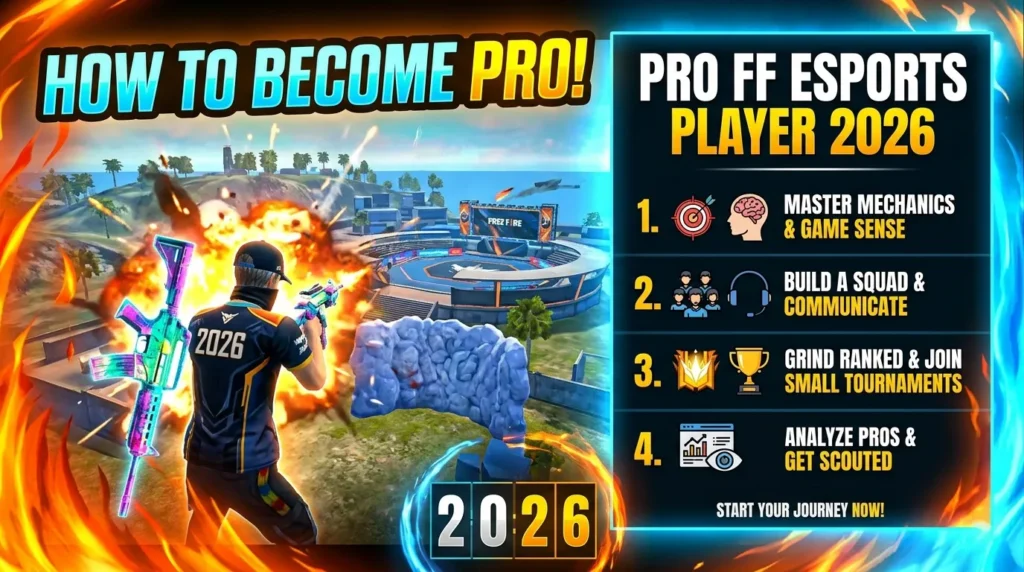
How to Become a Professional Free Fire Esports Player in 2026
Most players who ask “how do I go pro in Free Fire?” already know the obvious answer: get better. What they actually need to know is what the path looks like after that — because the gap between “very good player” and “signed player competing in the FFWS” involves specific steps that most guides never spell out.
The Free Fire competitive ecosystem in 2026 is bigger than it’s ever been. Garena expanded the FFWS Global Finals from 18 to 24 teams, added a standalone Clash Squad tournament as a second competitive pathway, and confirmed Free Fire’s return to the Esports World Cup in Riyadh from July 15–18. More slots exist at the top. The pipeline to reach them is structured and, if you understand how it works, navigable.
Here’s the honest version of how it actually happens.
The Skill Baseline You Need Before Anything Else
Nobody gets scouted from Diamond rank. The floor for professional consideration is Grandmaster — and not barely Grandmaster, but consistently Grandmaster across multiple seasons with KDA and placement stats that demonstrate you’re not just surviving to final circles but winning fights and influencing outcomes.
Before worrying about teams or tournaments, your benchmark should be this: are you regularly finishing top 5 in ranked matches? Not occasionally. Not when you get a lucky drop. Regularly, against the player pool in your server. If that’s not where you are yet, every other step on this list is irrelevant until it is.
The specific skills that separate “good ranked player” from “player who gets tryout consideration” are different from what most guides emphasize:
Positioning and zone management matter more than aim at the professional level. Teams that reach FFWS play with coordination and timing that makes individual aim somewhat secondary. If you can’t read a final circle and position your team advantageously before the zone forces a fight, no org will look at you regardless of your headshot rate.
Consistency under pressure is what coaches actually watch for. A 30-kill game one day and seven kills the next is less valuable than a player who puts up 12–18 kills per session, match after match, in different scenarios. Coaches want players they can predict.
Role mastery is non-negotiable at the pro level. Every competitive squad runs defined roles — entry fragger, support, IGL (in-game leader), and anchor. The players who get signed aren’t generalists; they’re players who have identified their role and optimized for it specifically. Figure out yours early.
Common Mistake: Grinding ranked solo and assuming it translates directly to pro play. Solo ranked develops your individual mechanics, but professional Free Fire is a squad game. The IGL skill of communicating position decisions in real time, or the support skill of tracking teammate HP and positioning during a push — these don’t develop in solo queue. You need consistent squad practice.
Reviewing Your Own Gameplay Like a Pro Does
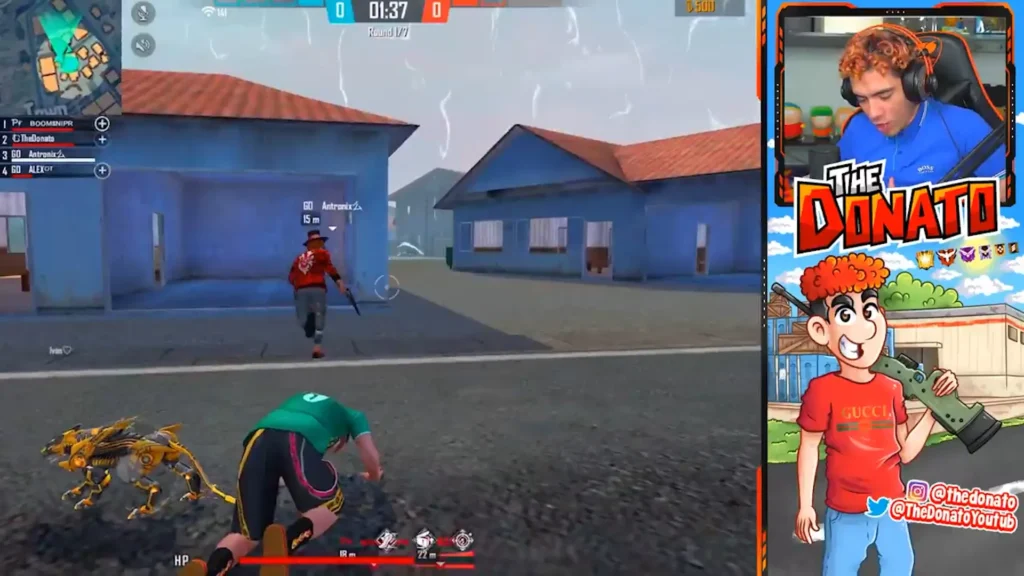
The players who improve fastest aren’t the ones who play the most hours. They’re the ones who review what they played.
After every ranked session, pull up your match replays and ask three questions: Where did I die, and was it avoidable? Where did I get kills, and was it because I played well or because my opponent played poorly? And — hardest question — where did I make a decision that felt right but cost my team something?
Pro players and coaches in organized Free Fire programs watch VODs with a focus on decision trees, not aim. The question isn’t “did the shot land” — the question is “should I have taken that fight at all given my team’s positioning and the zone timer?”
If you’re serious, find one or two players in your regular squad who are willing to do post-match reviews together. Talking through positioning decisions out loud develops game sense faster than any amount of additional gameplay. This is how competitive teams at every level actually improve between scrimmages.
Pro Tip: Record your sessions and watch them back at 1.5x speed without sound. Removing the audio forces you to focus purely on movement, positioning, and decision-making rather than reaction time. Problems in your game sense become obvious fast.
Building Your Community Profile Before You Need It
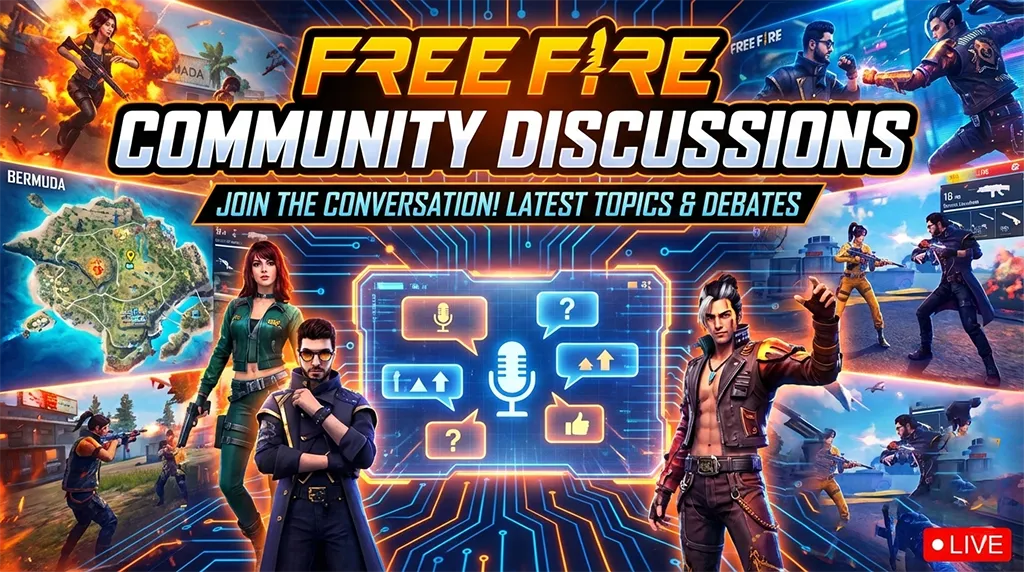
Nobody gets picked up from nowhere. Every Free Fire player who has signed with an organization was known in the community before the signing happened — through content, tournament history, or reputation within competitive circles.
You don’t need a YouTube channel or 50,000 followers. You do need some kind of visibility. That might be a TikTok clip that circulates in Free Fire groups. It might be consistent tournament results that show up on Liquipedia. It might be a reputation within your regional Free Fire Discord as a player who consistently performs in scrimmages and custom rooms.
What you’re building at this stage is a trackable record. When an org manager or scout gets your name mentioned, they need to be able to look somewhere and see evidence. A clean social media profile showing recent tournament results, ranked statistics, and gameplay clips is a basic requirement — not a bonus.
Quick Note: In India specifically, Free Fire operates through the Max version, and the competitive scene runs through regional qualifiers that feed into international events. Indian players interested in the FFWS pathway should monitor Garena’s official channels for regional circuit announcements, as the competitive structure for the subcontinent has its own qualifier format.
Understanding the 2026 Tournament Pathway
This is the section most “how to go pro” guides skip entirely, and it’s the most important structural knowledge you need.
Free Fire’s competitive system in 2026 works as a pyramid. At the base are open qualifiers — in-game tournaments accessible to any player or team that meets the minimum requirements. Above that are national leagues (FFWS BD, FFWS NP, FFWS VN, FFWS TH, FFWS MY, FFWS USA, and others). Winning or placing highly at the national level earns a team entry into the regional super-league. The regional leagues — particularly FFWS SEA, FFWS MENA, FFWS AF, and others — then feed into the two global peaks: the Esports World Cup (July 15–18, 2026, Riyadh) and the FFWS Global Finals (November 2026, Bangkok, Thailand).
The 2026 season also introduced a standalone Clash Squad tournament operating independently from the FFWS system. This is a second competitive pathway that didn’t exist before — one specifically designed for 4v4 specialists who may not thrive in the Battle Royale format. If your strengths are close-range mechanical play and tight coordination over zone management and large-scale positioning, the Clash Squad circuit might actually be your faster path into organized competition.
Here’s how to enter this pipeline as an unknown player:
Step 1 — Form or join a serious squad. Open qualifiers require a team. Find players at or near your rank who take the game seriously and commit to a regular practice schedule. This squad doesn’t need to be polished — it needs to be consistent.
Step 2 — Enter every open qualifier you can. Results build your team’s profile. Even early-round exits contribute to your Liquipedia history and show that your team is competing, not just claiming to be competitive.
Step 3 — Track your region’s national league announcement calendar. FFWS regional qualifiers run on seasonal schedules. Missing the registration window means waiting an entire split. Follow Garena’s official Free Fire esports channels and check Liquipedia’s Free Fire section regularly.
Step 4 — Perform consistently in tournament settings, not just ranked. Tournament pressure is different from ranked. Players who thrive in ranked sometimes collapse in tournament play because the mental game shifts when results are permanent. Getting tournament reps early prepares you for this.
What Esports Organizations Actually Look for When Scouting
This is where most aspiring pros have the biggest misconceptions. Org managers are not just watching for the player with the highest kill count. Here’s what actually drives signing decisions:
Attitude and coachability is consistently mentioned first by anyone who has managed a Free Fire roster. A player who hits back at criticism, blames teammates in post-match reviews, or can’t adapt their playstyle to a team’s tactical structure is a liability regardless of their individual skill. Coaches are working with you for months. They need to know you can take feedback and implement it.
Role fit and depth matters more than peak performance. Orgs don’t scout for “the best player available” — they scout for a specific role gap in an existing roster. A team that has strong fraggers but a weak IGL is looking for someone with game sense and communication skills, not another rusher. Understanding this makes you a better candidate because you can present yourself as a solution to a specific problem.
Availability and professionalism gets underestimated by young players. Being reachable, showing up to scheduled scrimmages on time, communicating clearly in team chats, and handling loss without spiraling — these soft skills determine a player’s longevity in organized esports environments. Teams at the FFWS level practice daily. If your schedule can’t accommodate that, no org will take the risk.
Trackable history closes the deal. Tournament results on Liquipedia, recorded scrimmage performance, consistent ranked stats visible through profile screenshots or third-party tools — the evidence needs to exist somewhere outside of what you say about yourself.
The Realistic Timeline (And Why Most Players Quit Before It Happens)
Going from a strong ranked player to a signed professional in Free Fire takes, realistically, one to three years of consistent competitive activity. Not playing ranked — competing in organized tournaments, reviewing footage, practicing with a committed squad, and building your profile continuously.
The players who don’t make it aren’t usually the ones who lack skill. They’re the ones who expect results faster than the ecosystem can deliver them and stop competing after a few early exits. The FFWS teams you watch at global events spent years in national qualifiers before they got there. EVOS Esports, who won the 2025 Esports World Cup, has players with years of competitive history — their current roster didn’t appear at a global event after six months of grinding ranked.
There’s a version of this journey that doesn’t end at the FFWS but is still a legitimate professional career: creating content around competitive gameplay, coaching other players, or building a profile as a community-recognized competitive figure. The 2026 ecosystem has room for all of these, and many players who originally aimed at playing professionally have found sustainable careers in adjacent roles. Keep that in mind when measuring your own progress.
FreeFireNation Recommendation: Follow our Esports section for coverage of FFWS qualifiers, team results, and player spotlights that can help you understand the competitive landscape in your region.
Building the Skills That Compound Over Time

The fastest-improving competitive Free Fire players share a few habits that aren’t exciting but are consistent:
They practice a specific mechanic or scenario for 30–45 minutes before starting their ranked session — not just loading into ranked cold. They identify one thing they want to improve each week and track whether they improved it. They watch tournament VODs (FFWS, EWC) not for entertainment but specifically to understand why top teams make the positional decisions they do. And they have at least one person in their circle who gives them honest, critical feedback on their game — not a hype-man, but someone who will tell them when their plays are wrong.
None of this is complicated. Most players don’t do any of it.
If you’re serious about Free Fire esports as a real goal rather than a fantasy, the gap between you and the players currently competing at FFWS isn’t usually about raw mechanical talent. It’s about structured practice, competitive activity, and the patience to build something over years rather than months.
The slots at the top of the 2026 competitive season are real. More of them exist now than ever before. The question is whether you’re willing to build the record it takes to get there.
Check our Creator Spotlight section to see how players have built competitive and content careers simultaneously in the Free Fire ecosystem.
FAQ
What rank do I need to be to go pro in Free Fire?
Grandmaster is the practical minimum rank that makes a player worth watching at a competitive level. However, rank alone doesn’t qualify you for professional play — consistent performance in organized tournaments and scrimmages matters more to esports organizations than your ladder placement.
How do I join the FFWS competitive circuit in 2026?
The pathway starts with open qualifiers at the national level. Register a team, enter every open qualifier in your region, and build a tournament history. National circuit announcements are posted on Garena’s official Free Fire channels and tracked on Liquipedia’s Free Fire section. Missing registration windows means waiting an entire split, so monitor the calendar closely.
Is the Free Fire Clash Squad tournament a separate path to pro play in 2026?
Yes. Garena introduced a standalone Clash Squad tournament in 2026 that operates independently from the FFWS Battle Royale system. It’s specifically designed for 4v4 specialists and doesn’t affect FFWS points or slots, giving close-range mechanical players a dedicated competitive pathway that didn’t exist before.
Do Free Fire pro players earn a salary?
Players signed to organizations that compete at FFWS or EWC level typically receive salaries, though amounts vary significantly by region and organization size. Prize pools at major events like the FFWS Global Finals and EWC provide additional earnings — the 2026 FFWS SEA Spring alone carries a $300,000 prize pool. Lower-tier and semi-pro players may compete for prize money without a base salary.
How many teams compete at the FFWS Global Finals in 2026?
The 2026 FFWS Global Finals expanded from 18 to 24 teams, taking place in Bangkok, Thailand in November. This expansion opens slots for new regions including Africa, Nepal, and the USA — meaning more national ecosystems now have a direct path to the game’s highest competitive stage.
The honest truth about going pro in Free Fire is that it’s a slow, structured process that rewards players who stay in the ecosystem longer than everyone who burns out expecting fast results. The 2026 competitive season has more entry points and more slots than any previous year. The first step isn’t complicated — it’s just committing to consistent, structured practice, entering qualifiers, and building a record that scouts and managers can actually find when your name comes up.
What role are you aiming to master first? Drop it in the comments and check out our Free Fire Tools page to sharpen the mechanics around it.
Read Next
- Free Fire Esports Coverage — Latest FFWS results, team news, and tournament updates
- Creator Spotlight — How Free Fire players built careers in and around competitive play
- Free Fire Tools — Sensitivity calculators and stat tools for competitive improvement

Written by
Free Fire Nation Team
Free Fire Nation is a dedicated gaming editorial team covering Free Fire news, weapon guides, esports, and redeem codes since 2019. All content is tested in-game and verified against official Garena sources.